This is the basic walkthrough for setting up an account once a company is willing to try you. If your shop is already established and busy, start with How to Get Fleet Accounts as an Established Auto Repair Shop.
A fleet account is an ongoing service relationship with a local company that owns or runs several vehicles. Oil changes, brakes, tires, inspections, and repairs come back through the year, which is steadier than waiting for the next walk-in. Before you set the account up, it helps to be clear about the work your shop can handle, how you will reach the decision maker, and how the first job should go. This guide walks through those steps, then covers the approvals, billing, and vehicle list that make the account easy to keep. At Super Eagle Auto Care in Charlotte, that setup is the point where a company that has already agreed to try us becomes an account we can keep.
What are fleet accounts?
A fleet account is an ongoing service relationship between your shop and a business that owns or runs several vehicles, such as a plumbing contractor’s vans or a delivery company’s trucks. Instead of one visit, the business keeps sending its vehicles to your shop for maintenance and repairs, usually under agreed terms for who approves work and how it is billed. The owner, operations manager, or fleet manager at that business is usually the person who decides which shop gets the work.
Step 1: Decide what fleet work your shop can actually handle.
Before you call anyone, get honest about what you can deliver. A fleet manager cares about one thing above everything else: getting vehicles back on the road. Promising more than your shop can handle is the fastest way to lose an account you worked hard to win.
Write down the answers to a few questions:
- Which vehicles can you service? Cars, light trucks, cargo vans, and SUVs fit most shops. Box trucks, diesel work, or heavy-duty equipment may not.
- How much capacity do you have? Think about bays, technicians, and how many extra vehicles you could take in a typical week without pushing your retail customers aside.
- What can you offer that a dealer or chain can’t? Faster turnaround, a direct line to the owner, early drop-off, after-hours key drop, or a shuttle are all worth mentioning if you really provide them.
- What payment terms can you carry? Many businesses expect to be invoiced instead of paying at pickup. Decide up front whether you can offer monthly invoicing and how long you can wait to be paid.
This becomes your fleet offer. Keep it short enough that you could explain it on a phone call in under a minute.
Step 2: Build a list of local businesses with vehicles.
Your best prospects are businesses near your shop that run the kind of vehicles you already service. Good places to start include plumbing, HVAC, and electrical contractors; landscaping and lawn care companies; pest control and cleaning services; property management companies; couriers and local delivery businesses; and contractors in the building trades.
A few practical ways to find them:
- Look at the road. Lettered vans and trucks parked at job sites, supply houses, and gas stations near your shop tell you exactly who has vehicles in your area.
- Search online maps for business categories in your service area and note the company name, phone number, and address.
- Ask your current customers. Some of your retail customers own or work for businesses with vehicles. They already trust your shop.
- Join local business groups such as your chamber of commerce or a networking group, where business owners are already open to meeting local vendors.
Put every prospect in one place with the company name, phone number, address, and any contact details you can confirm. Check for duplicates before you add a company so two people don’t call the same business without knowing it. For more on where to look, see our guide on how to find fleet customers, including how to spot companies with fleet vehicles near you.
Step 3: Find the person who makes vehicle decisions.
The person who answers the phone usually isn’t the one who decides where the vans get serviced. In a small business it may be the owner. In a larger one it could be an operations manager, office manager, or fleet manager. Your first job is simply to learn who that person is.
“Hi, this is Sam from Main Street Auto, a repair shop here in town. Who takes care of maintenance and repairs for your company vehicles?”
If they give you a name, ask for the best way to reach that person and when they are usually available. Write it down right away. A name and a good time to call turn a cold call into a warm one the next time you reach out.
Step 4: Make the first contact about their problem, not your shop.
When you reach the decision-maker, skip the long pitch. Ask a few questions and listen:
- What kinds of vehicles do you run, and roughly how many?
- Where do they get serviced now?
- What frustrates you most about keeping them on the road?
- How do you handle preventive maintenance today?
Their answers tell you whether they are a fit and what to emphasize. If downtime is the problem, talk about turnaround and scheduling. If they struggle to keep track of service, talk about maintenance reminders and keeping a service history for each vehicle. Only offer what your shop can really do.
Calling is only one way in. A short visit with a business card and a one-page service sheet, a mailed letter, or a brief email can all work, especially when you combine them. Whatever channel you use, end with a specific next step, such as sending information, calling back on a set day, or stopping by to meet in person.
Step 5: Follow up until you get a clear answer.
Very few fleet accounts are won on the first contact. The business may be happy enough with its current shop, the right person may be busy, or the timing may be wrong. Most of the work of winning fleet accounts happens in the follow-up, and most shops stop too soon.
A simple follow-up rhythm keeps you in front of them without being a pest:
- After the first conversation, send whatever you promised the same day.
- Call back when you said you would, and reference what they told you last time.
- Mix in a visit, a mailed piece, or an email so every touch isn’t the same phone call.
- If they say “not right now,” ask when a better time would be and set a reminder for that date.
- If they ask you to stop contacting them, respect it and mark it so nobody on your team calls again.
The key is writing down what happened after every touch. A note that just says “called” is useless three weeks later. A note that says who you spoke with, what they cared about, and what you agreed to do next lets you pick up the conversation exactly where you left off.
Step 6: Ask for one vehicle, not the whole fleet.
Asking a business to move its entire fleet to a shop it has never used is a big request. Asking them to try you on one vehicle is easy to say yes to.
“Would you be open to sending us one vehicle that’s due for service? We’ll show you how we handle it, and you can decide from there.”
Treat that first job like an audition. Call before doing any work beyond what was approved, explain your findings in plain language, send photos if you use digital inspections, finish when you promised, and make the invoice easy to read. A smooth first job is often the strongest sales pitch you have.
Step 7: Set the account up so it’s easy to keep.
Once a business agrees to use your shop, agree on the details before problems come up:
- Approval rules. Who can approve work, and is there a dollar amount you can do without calling first?
- Billing. Per-visit payment or a monthly invoice, purchase order numbers if they use them, and where invoices should be sent.
- Vehicle list. Each vehicle with its year, make, model, and an identifier the customer uses, such as a unit number, so invoices and service history are easy to match.
- Maintenance schedule. Agree on how you will remind them when vehicles are due so preventive maintenance actually happens.
- Point of contact. One person at your shop they can call, and one person at their company you report to.
Check in regularly, even when things are going well. Ask whether they are happy with turnaround and communication. Fleet customers rarely leave because of one repair. They leave when they feel taken for granted.
Step 8: Track every prospect in one system.
As your list grows, sticky notes and spreadsheets break down. You need to know at a glance which companies are new prospects, which are interested, which have become customers, and which asked you to stop. You also need to know who is due for a call, a mailing, an email, or a visit today.
If both the owner and an outside sales rep are working fleet accounts, a shared record matters even more. When the rep visits a business on Tuesday and the owner calls them on Thursday, the owner should see exactly what was discussed so the prospect doesn’t have to repeat themselves.
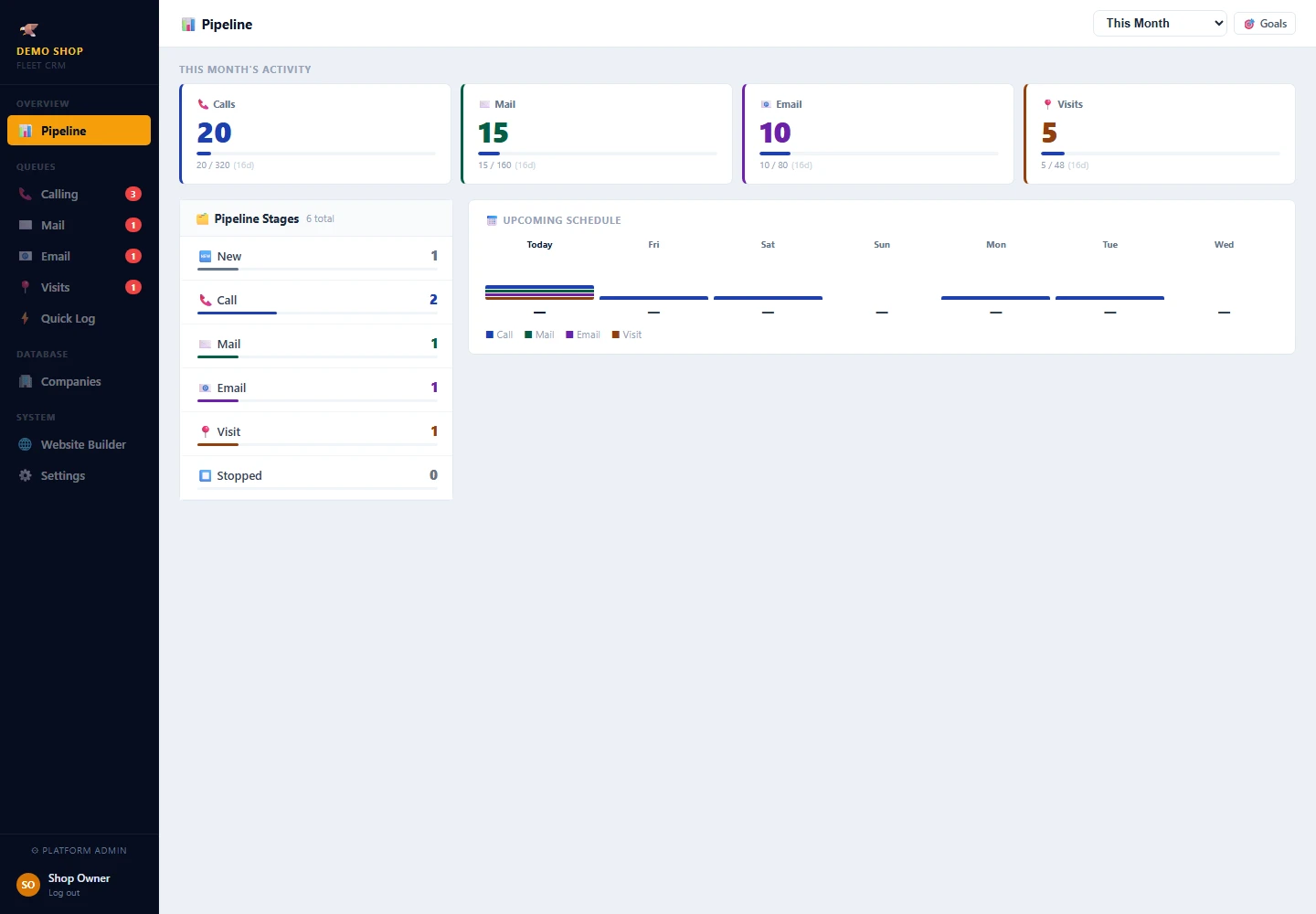
Fleet Searcher is a fleet prospecting tool built for this: it keeps your fleet leads for auto repair shops organized. Each company record keeps its contacts, notes, and call and visit history together, outreach queues show who is due for a call, mail, email, or visit, and every logged conversation ends with a next action so nothing falls through the cracks.
Common mistakes to avoid
- Leading with a discount. Price matters, but reliability and communication usually matter more. Discounts you can’t sustain lead to accounts you can’t keep.
- Calling without a plan. Know who you are calling, why your shop is a fit, and what next step you want before you dial.
- Not writing things down. Every conversation without a note is a conversation you will have to start over.
- Giving up after one try. “Not right now” is not “no.” Set a date and follow up.
- Overpromising. Don’t take vehicles you can’t service or turnaround times you can’t hit.
Getting started this week
You don’t need a big marketing budget to start winning fleet work. Write your one-minute fleet offer, build a list of local businesses with vehicles, and commit to a few outreach calls or visits each week. Log every conversation, set a next step every time, and follow up when you said you would. Over time, those small, consistent actions add up to a steady base of fleet customers.
Related reading
- How to Get Fleet Accounts as an Established Auto Repair Shop
- How to Find Companies with Fleet Vehicles Near Your Shop
- How to Find Fleet Manager Email and Contact Information
Turn your fleet prospect list into fleet accounts.
Fleet Searcher is a fleet prospecting tool for independent auto repair shops. Keep fleet prospects, contacts, conversation notes, outreach queues, and follow-ups in one place, for the owner and outside sales reps alike.
See how Fleet Searcher works →View pricing →Talk with us about your shop →